Begin with the home that already exists
Retrofit automation is most useful when it improves a home without asking the household to relearn every familiar action. The starting point is not a catalogue of gadgets. It is a room-by-room discussion about the lights, climate, blinds, access points and appliances that residents operate repeatedly or worry about after leaving home.
An electrician then checks the physical conditions behind that brief: the existing switch arrangement, neutral availability, enclosure space, circuit loading, equipment compatibility and network coverage. Those findings determine which controls can be introduced with minimal disruption and where additional work is justified. A retrofit pathway can often retain existing wiring and wall switches, but that outcome should be confirmed on site rather than promised from a floor plan.
A worked three-bedroom home example
Consider an existing three-bedroom Melbourne home where the owners want better control of living-area lighting, a compatible single-zone heating and cooling system, one bank of roller blinds, the garage door and front gate. An illustrative IA schedule could include two IA DIM4V1 modules for grouped lighting zones, one IA HVAC controller, one IA BC Controller, one IA DRY2V1 for the access interfaces and one IA 10A2CH for exterior lighting and another approved circuit.
That is a reference configuration, not an as-built design. The actual quantity changes with channel allocation, load type, switchboard layout and the compatibility of the connected equipment. Its value is that it makes the scope discussable: the electrician can see the likely control points, the owner can see which daily routines are covered, and the integrator can plan naming, permissions, scenes and handover before commissioning begins.
What does not need to change
A well-planned retrofit keeps everyday local control. Residents can still use compatible wall switches, guests do not need an app to turn on a light, and a cleaner or tradesperson can operate the home in an expected way. The app adds property-wide visibility, remote intervention and coordinated actions; it should not become the only way to perform a basic task.
The automation layer does not need to replace the NBN service, security panel or existing equipment that is outside the agreed scope. It can interface with compatible systems where the design calls for it, but each interface must be reviewed on its own merits. Standard retrofit work may avoid new conduit or extensive cable runs, yet difficult access, missing neutrals or unsuitable equipment can still require additional electrical work.
What the trade installation process looks like
Before arriving on site, the electrician or integrator needs the circuit schedule, equipment details, proposed module list, Wi-Fi credentials and the names that will appear in the app. On site, the work proceeds through isolation, verification, installation, local functional testing, network enrolment and commissioning. Each output should be proven locally before it is included in a scene or schedule.
Infinite Automation's current product pages describe short standard installation windows for individual modules under suitable conditions, including 15 minutes for the smart switch and 30 minutes for the dry-contact switch. Those figures are not a whole-project promise. Access, testing, remediation, switchboard work and commissioning can materially change the duration, so the licensed electrician should set expectations after inspection.
Commission around routines, not features
The first scenes should map to recognisable moments. Arrive home might prepare the entry path, living lights, blinds and comfort setting. Movie can adjust selected lights and blinds without affecting bedrooms. Away can turn off agreed circuits and show the state of connected access points. Morning can open compatible blinds and prepare the living area without waking the whole property.
Schedules deserve the same restraint. Start with one or two dependable actions, such as pre-conditioning before a regular arrival window and an overnight all-off check. After handover, the household can review what helps, what interrupts normal life and what should remain manual. Good automation becomes quieter as it improves.
What daily use feels like after handover
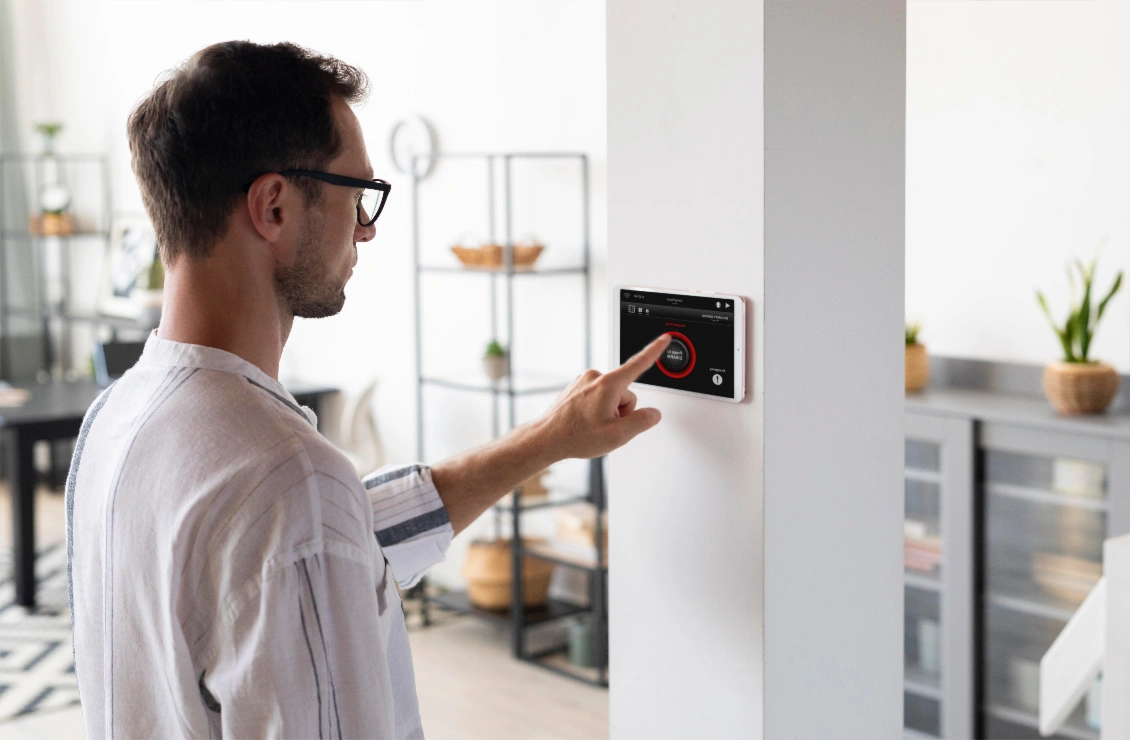
For residents, most interactions remain simple: use the wall switch, recall a favourite scene, check whether the garage is closed or adjust a room before arriving home. The app becomes valuable when several devices need to move together or when the owner is away from the property. Device names and room groups should use the language the household already uses.
Handover should include every authorised account, a plain-language device list, the purpose of each scene, the schedule windows and a support contact. It should also explain what happens if internet service is unavailable and which local controls continue to work. That knowledge is as important as the demonstration itself.
Plan the next stage before adding it
A modular system can grow, but expansion should still have a reason. Outdoor feature lighting, another climate zone, garden control or additional access can be noted as future scope during the first design. Recording that intent helps preserve channel capacity and makes later conversations faster.
The best retrofit outcome is not the home with the most automated circuits. It is the home where residents understand the controls, the electrician can support the installation, and each automated action removes a small piece of repeated effort without making the property harder to use.